
Essay / June 22, 2026
2026 NAACP Labor Award Recipient
I'm receiving the 2026 Benjamin L. Hooks Keeper of the Flame Award from the NAACP National Labor Committee
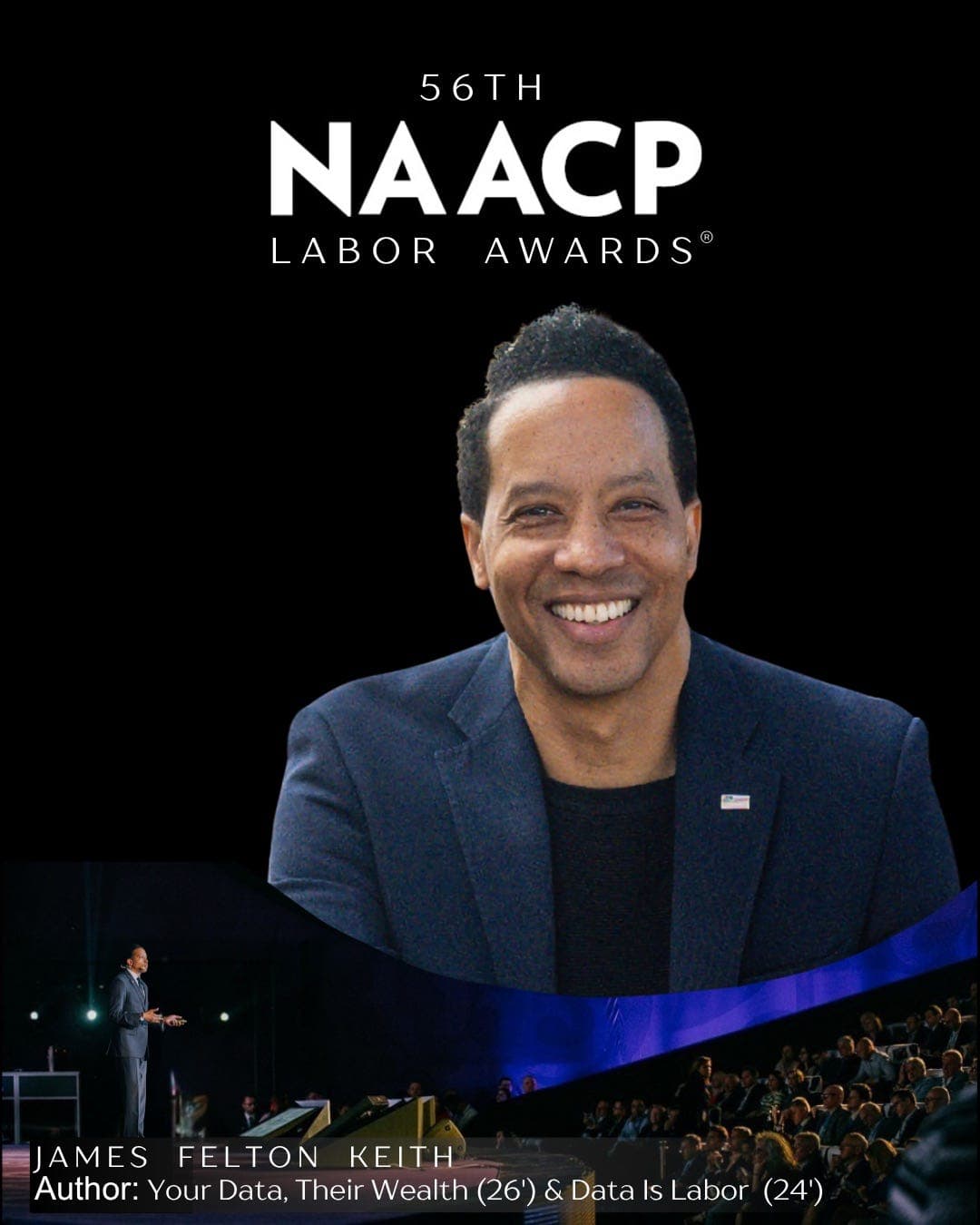
Keeper of the Flame, Keeper of the Future I am honored to accept the 2026 Benjamin L. Hooks Keeper of the Flame Award from the NAACP National Labor Committee .
I receive this recognition with gratitude, humility, and responsibility.
Benjamin L. Hooks stood in a tradition that understood a truth too many institutions still resist: civil rights and labor rights cannot be separated . If a person has dignity, then that dignity must follow them into the workplace. If a person has standing, then that standing must extend into the systems that profit from their labor. If a person has rights, then those rights must matter not only in law and principle, but in economics.
That is the spirit in which I accept this award.
I also accept it at a moment when the definition of labor is being contested in real time.
For generations, workers were told that labor meant the hours they could prove, the motions they could document, the products they could hold, the output an employer could count. But today, in the AI economy, value is increasingly generated in ways that do not fit those old categories. Our actions, choices, preferences, corrections, movements, relationships, histories, and digital traces are constantly being absorbed into productive systems. These systems call us users while using us. They call our contribution data while pricing it as if it appeared by magic.
My book, Your Data, Their Wealth: The Price of Human Input to the AI Economy , and our recent paper, “The Two Faces of the Invisible Economy: Pricing Personal Data Inputs and Measuring Machine Labor Outputs in the AI Economy,” make a simple argument with far-reaching consequences:
Human data input is not a byproduct. It is a factor of production.
And if that is true, then labor must evolve its bargaining strategy.
Get My Latest Book
The Next Frontier of Collective Bargaining For too long, collective bargaining has been limited by the categories the industrial economy handed to us. Wages. Hours. Benefits. Scheduling. Safety. Classification. Surveillance. Those remain essential. But they are no longer enough.
Because in the AI economy, workers are not only selling time. They are producing intelligence.
They are training models with their corrections. They are improving systems with their behavior. They are reducing uncertainty with their participation. They are generating value with every workflow, communication pattern, preference signal, and digital interaction that can be captured, aggregated, and monetized.
This means there is now a new terrain of bargaining:
the right to collectively bargain around personal data input as a new asset class.
That is the shift.
Not bargaining only about what a worker is paid after value is created. But bargaining about the very inputs from which that value is created in the first place.
What It Means to Bargain Around Personal Data To collective bargain using personal data is not to individualize labor. It is the opposite. It is to recognize that personal data, when captured at scale, becomes a collective economic resource. Workers do not merely produce widgets, code, services, or care. They also produce patterns, training signals, performance traces, and institutional intelligence.
Those inputs already affect productivity, profitability, risk scoring, workforce management, and investor valuation.
The problem is not that this value does not exist. The problem is that it is unrecognized where it matters most.
A new bargaining strategy must begin there.
It must ask:
What human inputs are being captured from workers in the course of productive activity?
How are those inputs being measured, classified, stored, and monetized?
