
Essay / June 11, 2026
On Transgender Rights in the Era of AI: Humanity Is a Coalition, Not a Category
I just left the New York City Comptroller’s Pride Month Breakfast honoring human rights organizers from across the city.
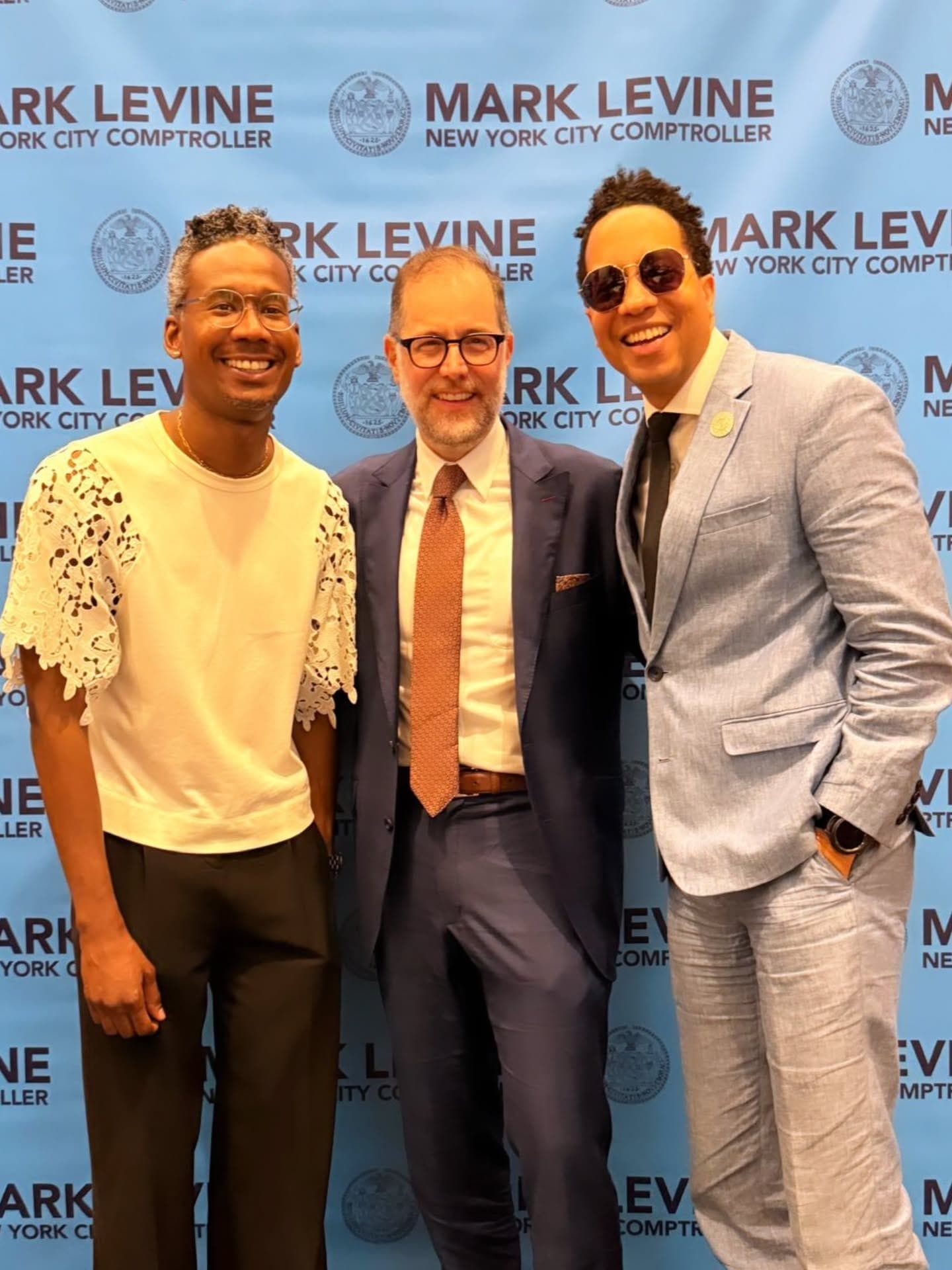
Andy Tarradath, Comptroller Mark Levine, James Felton Keith I just left the New York City Comptroller’s Pride Month Breakfast honoring human rights organizers from across the city.
The event was a reminder that progress is neither automatic nor permanent. The rights many people take for granted today were secured through decades of organizing, advocacy, and political struggle. Yet even as Pride Month celebrates those victories, transgender people find themselves facing renewed attacks across the United States. Access to healthcare is being restricted. Public recognition is being challenged. Legal protections that once seemed secure are increasingly contested.
At first glance, this may seem unrelated to another defining issue of our age: the rapid ascent of artificial intelligence and the technological transformation of human life.
Yet these subjects are more closely connected than many people realize.
The struggle over transgender rights is often presented as a dispute about gender. In reality, it is part of a much larger conflict over how society defines personhood, identity, and who has the authority to determine either one.
This question is not new.
Subscribe now
Throughout history, human societies have repeatedly drawn boundaries around belonging. Entire groups of people have found themselves excluded from full participation because they challenged prevailing assumptions about race, religion, disability, sexuality, nationality, or gender. Progress has rarely occurred because humanity discovered new rights. More often, it occurred because humanity expanded its understanding of who those rights belonged to.
The history of civil rights is, in many ways, the history of widening the circle of recognition.
This is the starting point of Inclusionism.
Inclusionism is not merely a political position. It is an observation about the trajectory of civilization. Again and again, societies become more stable, prosperous, and resilient when they learn to incorporate greater forms of human diversity. Conversely, periods of democratic decline are often marked by efforts to narrow the definition of who belongs.
The current attacks on transgender people should be understood within this historical pattern.
At their core, many anti-trans arguments depend upon a belief that identity can be determined entirely from external characteristics. The assumption is that legitimacy flows from conformity to fixed categories rather than from individual agency and lived experience. The debate may concern gender, but the underlying conflict is about authority. Who gets to define a person’s identity—the individual themselves, or the institutions and traditions around them?
For transgender people, this question is immediate and personal.
For the rest of society, it is becoming increasingly unavoidable.
The emergence of artificial intelligence, neural interfaces, advanced prosthetics, gene editing, and other transformative technologies is forcing humanity toward a future in which traditional categories will become less stable. Human beings are already altering their bodies through medicine and technology. Millions of people rely on artificial interventions to see, hear, move, communicate, and survive. Future generations may integrate technology into their bodies and minds in ways that are difficult to imagine today.
As these developments accelerate, humanity will encounter questions that once belonged exclusively to science fiction.
How much modification can a person undergo while remaining human?
If memory can be augmented through technology, where does identity reside?
If cognition can be enhanced, what constitutes authentic personhood?
And perhaps most importantly: what principles should govern our responses to forms of human diversity that previous generations never anticipated?
These questions are significant, but they are not the questions we must answer today.
One of the most important distinctions between transgender rights and transhumanist philosophy is that transgender people are living human beings seeking equal treatment in the present, while transhumanism often concerns possibilities that may unfold over decades or centuries.
We do not need to resolve every philosophical question about humanity before defending transgender rights.