
Essay / September 15, 2026
Reparations in Real Time
How our lives became data, our data became AI, and the value became someone else’s property
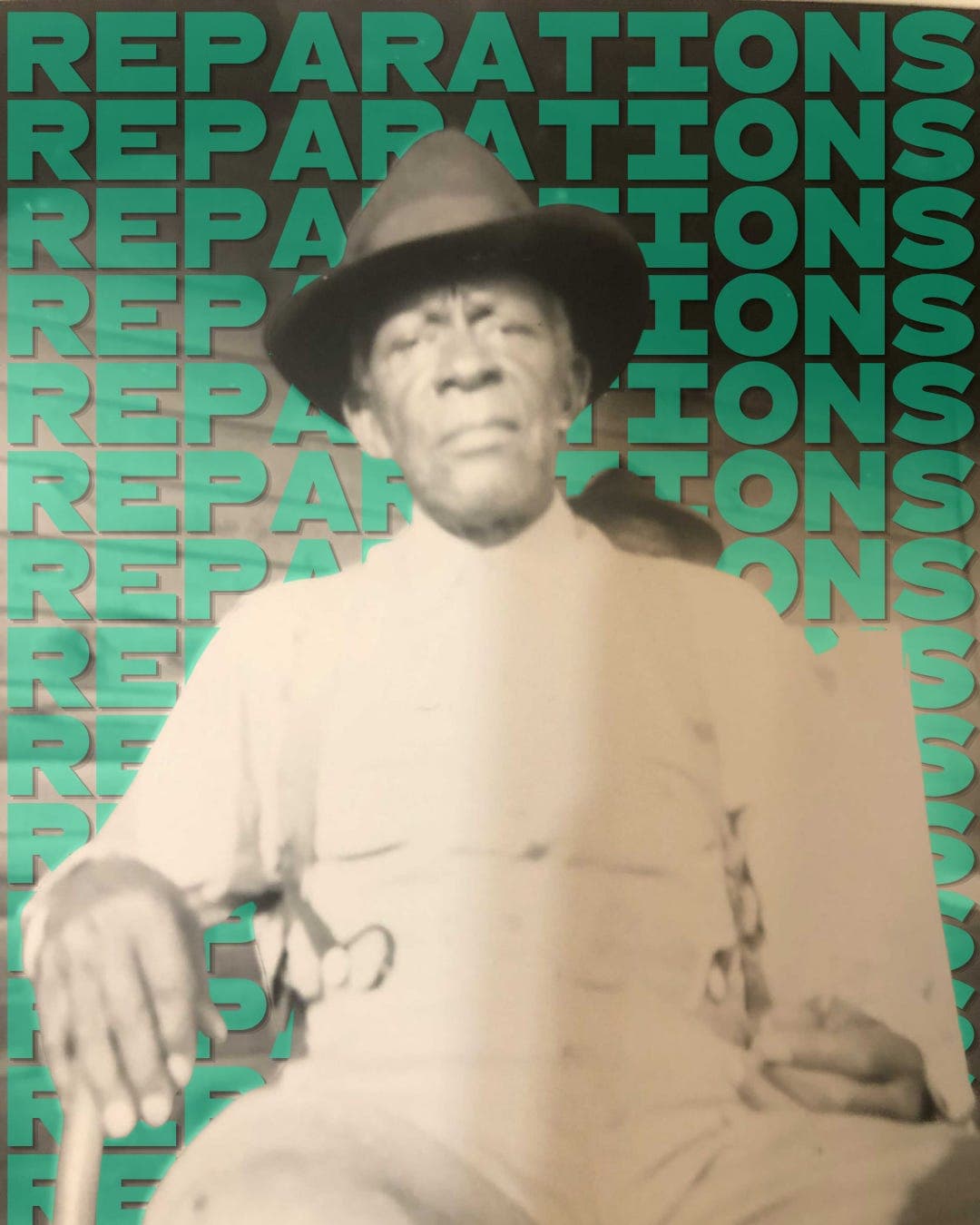
This is James “Papa Jim” Keith, my great-great-grandfather. He was born on September 15, 1871, six years after his parents were emancipated, and was the first James Keith in my bloodline born outside of slavery. He was a sharecropper forced off of his land by gun point which triggered much of his family moving to Newnan Georgia and as far away as Detroit Michigan. I carry his name. So in this essay I am not only asking an economist’s question when I write about: what value survives our contribution, what wealth compounds, what families inherit, and what an unpaid account means across generations… I am writing about a history that sits inside my own name.
I. The Question in Chicago After Angela Wells, the Human Rights Director of the Communications Workers of America, called my name , I felt the weight of the hundreds of labor organizers in the room.
I was in Chicago to receive the Benjamin L. Hooks Keeper of the Flame Award from the NAACP National Labor Committee. I had prepared remarks about labor, artificial intelligence, and the new forms of value workers produce in an economy increasingly built on information. But somewhere between my seat and the stage, I stopped thinking about the speech I had written and started thinking about the man whose name was on the award.
Benjamin Lawson Hooks had been the first Black commissioner of the Federal Communications Commission. When he arrived at the FCC in 1972, communications meant television stations, radio frequencies, broadcast licenses, telephone networks, and the enormous political question of who was allowed to own and operate the infrastructure through which Americans saw and heard one another. Hooks understood that communications systems were not neutral. Ownership shaped representation. Access shaped power. The ability to speak through the dominant communications infrastructure could help determine who was visible, who was heard, and whose interests entered the national conversation.
More than half a century later, I was standing before a room of labor leaders with an award bearing his name, trying to explain that communications had become something else as well.
They had become assets.
An email is now a data point. A Microsoft Teams conversation is a data point. A customer complaint is a data point. A worker correcting a mistake is a data point. A meeting, a route, a medical decision, a keystroke, a photograph, an exception to a routine, a conversation between two employees trying to solve a problem, all of these can become observations from which a machine learns something about the world.
I found myself wondering what Commissioner Hooks would have thought about that transformation. We spent the twentieth century fighting over who could own the television station. In the twenty-first, the communication passing through the station, the office, the computer, and the worker has itself become a productive asset.
That week, the strange economics of this new world had become almost literal. Google had agreed to pay $10 million in a bankruptcy auction for access to a vast body of Spirit Airlines enterprise data, including roughly 100 million emails and 500 million Microsoft Teams chats, along with other business records. The airline could fail. Employees could lose their jobs or move on. Offices could close. Aircraft could change hands. But the accumulated record of how thousands of people communicated, coordinated, solved problems, made decisions, and operated an airline still possessed enough prospective value that one of the most sophisticated technology companies in the world was willing to bid millions of dollars for access to it.
The workers had already been paid for their work.
What had paid them for what their work had taught the machine?
That was the question I had come to Chicago to put before organized labor. Unions have spent generations developing systems for bargaining over the recognized products and conditions of labor: wages, pensions, benefits, safety, seniority, scheduling, discrimination, layoffs, and the conditions under which human effort is sold. Yet workers increasingly produce another economically consequential input while performing the work for which they are paid. Their decisions, corrections, routes, judgments, conversations, mistakes, patterns, exceptions, and solutions become observations. Those observations can be aggregated. Aggregated information can improve prediction. Better prediction can improve decisions. Better decisions can lower costs, increase revenues, reduce risk, automate tasks, and raise the value of an enterprise.
The wage may compensate the worker for performing the task. It does not necessarily compensate the worker for producing an informational asset that continues to create value after the task has ended.
That distinction is the basis of what I have called Data Is Labor. But over time I came to believe that saying data has value was not enough. Almost everyone in the modern economy now understands that data can be valuable. The more difficult question is whether we can determine what portion of that value comes from the people whose activities produced the information in the first place.
If we can measure that contribution, then something changes. A conversation about privacy becomes a conversation about production. A conversation about consent becomes a conversation about ownership. A conversation about technological displacement becomes a conversation about income. And a worker who has been told to think of himself primarily as a person vulnerable to automation can begin asking whether he is also one of the people who supplied the informational inputs that made the automation economically useful.
I tried to make that case to the labor leaders in Chicago. A union entering negotiations over artificial intelligence should not ask only whether the machine will replace workers. It should ask what the machine learned from workers before it became capable of replacing any portion of their work. It should ask which observations improved the system, what uncertainty those observations removed, how the improvement affected productivity, and where the resulting value appears in the accounts.
When I stepped off the stage, the question came back to me in a form I had not expected.
Theodis Pace, president of the Illinois State Conference of the NAACP, approached me with a group of men. Illinois was itself wrestling with new rules governing artificial intelligence, data, safety, and the rights of the people affected by these systems. But Pace’s question was larger than regulation.
Was this how we get reparations?
The question stopped me because I understood immediately why he had heard reparations inside an argument about information.
I had been describing an economy in which people contribute something productive, institutions accumulate the resulting value, and the prevailing accounting system has no obvious place in which the contributor’s share appears. The worker may be paid for performing a task while simultaneously producing an informational asset whose value accrues somewhere else. The activity ends, but the information remains. The information improves prediction. Prediction improves productivity. Productivity can increase the value of the asset and the institution that owns it. The contributor can disappear while the contribution compounds.
Black Americans have heard some version of that story before.
Chicago was an appropriate place to ask the question.
In 2014, Ta-Nehisi Coates made Chicago one of the central landscapes of “The Case for Reparations.” His essay forced millions of Americans to consider reparations not merely as an argument about slavery, guilt, or history, but as an account. Coates began with Clyde Ross, a Black man who grew up in Mississippi, watched his family’s property taken, moved north, served his country, worked, married, raised children, and attempted to do one of the most ordinary things an American family could aspire to do in the middle of the twentieth century: buy a house.